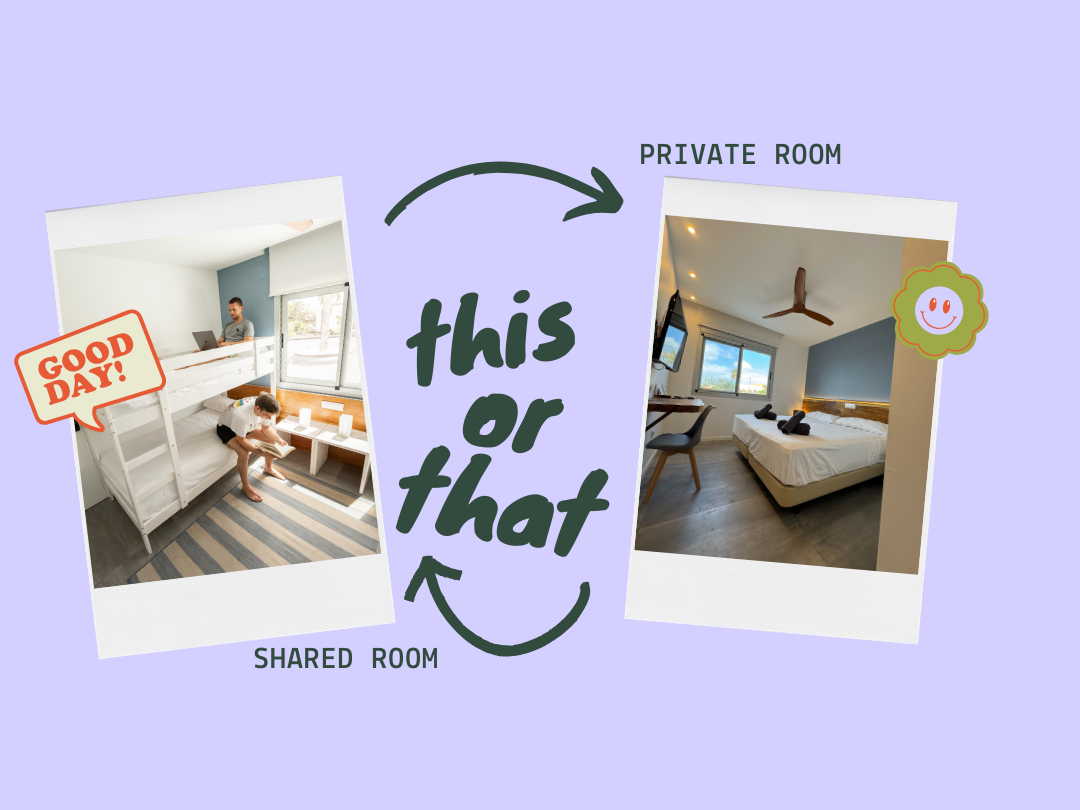
Do you have a private room?
This is usually one of the first questions people ask us.
Not about surfing.
Not about the island.
About the room.
“I’m not sure if I should book a shared room or a private one.”
What’s interesting is how early this question comes up. Sometimes before flights are booked. Sometimes before people really know what kind of surf camp they’re joining. On the surface, it sounds like a comfort decision. In reality, it’s usually about something else.
It’s about space.
About closeness.
About how much interaction feels right.
And most people don’t have a clear answer to that yet. They just feel the tension.
Why people choose a surf camp in the first place
If all you wanted was to surf, there would be easier ways to do it.
You could book an Airbnb, take surf lessons, and spend the rest of the day on your own. You could decide exactly when to be around people and when not to. From a purely practical point of view, that’s often the simpler option.
People don’t choose a surf camp because it’s the most efficient way to surf. They choose it because they want something around the surfing.
Very often, that something is people.
Shared meals instead of eating alone. Familiar faces over the course of a week. A sense of being part of something without having to build it from zero. Even people who describe themselves as “not very social” usually crave some form of human interaction — not constant, not intense, but real.
A surf camp creates a framework for that. And the room you choose plays a bigger role in this than most people expect.
The private room
A private room feels like the safe option.
You have your own space. Your own rhythm. A door you can close when the day feels full. For some people, especially those coming from very busy or demanding phases of life, that sense of control matters a lot.
There’s absolutely nothing wrong with choosing that.
But it does shape how the week unfolds.
With a private room, it’s easier to retreat. Easier to skip moments without really noticing. Not because you don’t want to connect, but because you don’t have to. You can always step out, reset, and rejoin later.
That distance isn’t negative. It’s just real. It creates a slightly different experience — one with more separation and more self-contained time.
For some guests, that’s exactly what makes the week enjoyable.
Why shared rooms create something different
Most people hesitate before booking a shared room.
They worry about not fitting in, about age differences, about being quieter than others, about being “too much” or “not enough.” These thoughts rarely come from insecurity alone. More often, they come from awareness.
Interestingly, the people who ask these questions are usually the easiest to share space with.
In shared rooms, connection doesn’t need to be planned. You talk because you’re there. You laugh because something small is funny. You’re quiet together because everyone’s tired. None of it needs to be initiated or managed.
It’s not forced. It’s not intense. It’s simply shared.
And that makes a difference, especially in the first days of a surf camp, when everyone is still settling in.
Friction — and why it helps
A shared room adds friction.
You can’t fully disappear. You acknowledge each other. You exchange small words without planning to. You notice how someone’s day went just by being around them.
That friction is often seen as something to avoid. But in a surf camp, it’s usually what helps people connect more quickly.
Those tiny interactions — saying good morning, brushing your teeth next to someone, laughing about something insignificant — lower the barrier to belonging. You don’t have to figure out how to “join” the group. You’re already part of it.
For people who are shy or hesitant, this is often the paradox: going all the way actually makes it easier.
You don’t have to perform being social. You don’t have to put yourself out there in a big way. Presence does the work for you.
What this choice is really about
Most people think they’re choosing between comfort levels.
They’re not.
They’re choosing how much closeness they allow. How much overlap. How much unplanned interaction they’re open to during the week.
A private room gives you more control and clearer boundaries.
A shared room gives you more proximity and shared rhythm.
Neither option makes you a better or worse guest. But they do lead to different experiences.
How we see it at Kyuka
We’ve seen people in private rooms who were deeply connected to the group. And we’ve seen people in shared rooms who stayed mostly to themselves.
So no — the room doesn’t decide everything.
But when someone tells me, “I’m nervous about the shared room, but part of me feels drawn to it,” that usually says a lot. Curiosity matters here. And certainty rarely does.
Often, the shared room simply makes inclusion easier. It removes a few steps. It lets connection happen without effort.
If you’re trying to decide
Don’t ask what’s better.
Ask what do you need right now?
Do you need clear boundaries to feel safe and rested? Or do you want to make it easier for yourself to be part of the group, even if that feels unfamiliar at first?
Both answers are valid.
Just try not to choose the option that protects you from an experience you quietly want.
That’s usually the only real mistake.