If you have never surfed before, you might wonder how many lessons you actually need before things start to make sense. Is one enough, do you need a few days, or is a full week better? There is no exact answer because everyone learns at a different pace. Some people stand up during their first session, while others need more time before they feel comfortable on the board.
Your balance, fitness, confidence in the ocean and previous sports experience can all make a difference. The conditions matter too, because a calm day can feel very different from a bigger or windier one. What most beginners notice is that a few lessons close together help much more than one isolated session. That is one reason staying at a surf camp in Fuerteventura can work so well for beginners: you get several chances to practise while everything from the previous session is still fresh.
Your first lesson introduces the basics, while the next sessions are where those basics start to feel more natural. After a few days, you are usually thinking less about every individual movement and paying more attention to the waves around you.
What Happens During Your First Surf Lesson?
Your first lesson is mostly about getting used to something completely new. Before you enter the water, your instructor will usually explain how to lie on the board, paddle and pop up. You will also learn where your feet should land and how to stay safe in the water. At a local surf school in Fuerteventura, the lesson will also depend on the conditions that day.
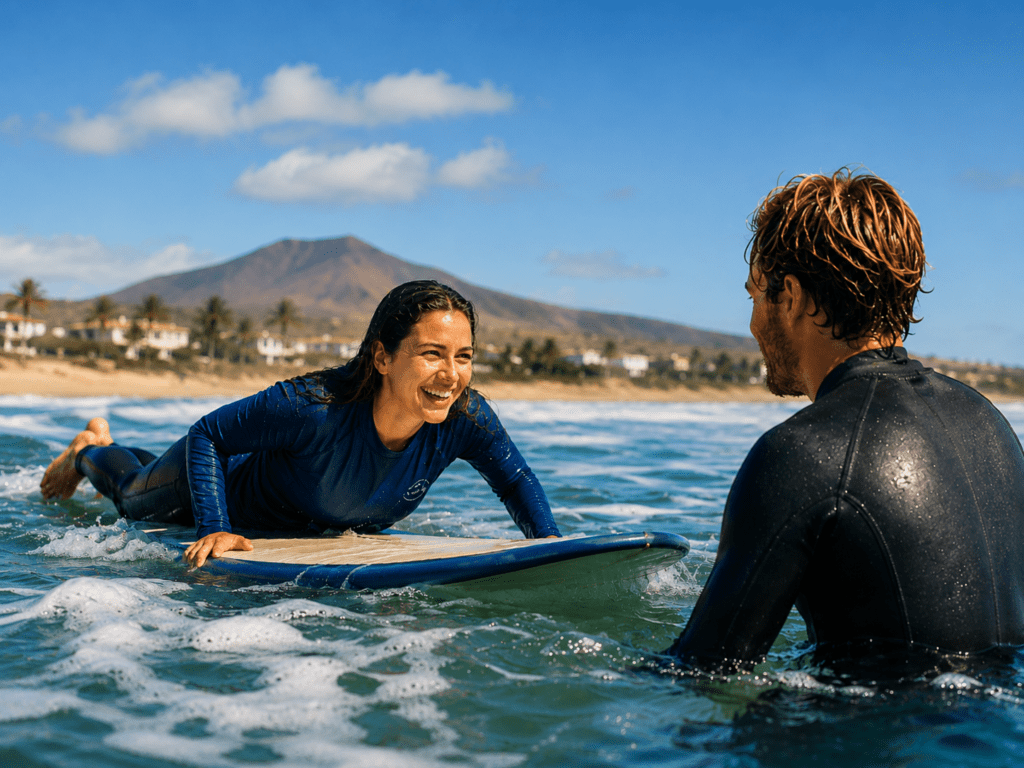
Once you get into the ocean, everything usually feels a little harder than it did on the beach. The board moves underneath you, the water pushes you around and that simple pop-up suddenly takes much more timing and balance. Most beginners start in the whitewater, which means waves that have already broken. This gives you more time to focus on the basic movement without also worrying about wave selection and positioning.
The first lesson is not about doing everything perfectly. It is about getting comfortable with the board and starting to understand how surfing feels. Some people stand up quickly, while others need more attempts before it clicks. If you want a better idea of what the first few days are like, our guide on what you can actually expect from your first week surfing goes into more detail.
Is One Surf Lesson Enough?
One lesson can be enough if you simply want to try surfing and see whether you enjoy it. You can learn the basics, catch a few waves and get a good first impression of what the sport is like. Some beginners even stand up during their first session, which is always a great feeling. But standing up once is very different from understanding how to surf on your own.
During your first lesson, the instructor is making many of the decisions for you. They help you choose waves, tell you when to paddle and correct your position after each attempt. When you come back for a second or third session, you start recognising some of those things yourself. You begin to notice which waves look better, when you need to paddle and what you did differently when one attempt worked.
Fuerteventura is particularly interesting for beginners because there are different types of surf spots around the island. As we explain in our guide to beginner surfing in Fuerteventura, having different coastlines gives instructors more options when deciding where to surf. That does not mean the conditions are easy every day, but it gives you a better chance of finding a suitable place to learn.
What Changes After Two or Three Surf Lessons?
After a few sessions, surfing usually starts to feel less chaotic. You become more comfortable on the board, your paddling starts to improve and your pop-up feels more natural. Instead of thinking about every movement separately, some of it starts to happen automatically. That makes it easier to pay attention to the wave and what is happening around you.
This is also when you start noticing your own mistakes. Maybe you are looking down when you stand up, your feet are too far back or you stop paddling too early. These are small details, but fixing one can completely change how your next wave feels. A little improvement in timing or body position can make the difference between falling straight away and getting a proper ride.
Surfing several days close together helps because the previous session is still fresh in your mind. You can work on the same mistake again the following morning instead of trying to remember it weeks later. That repetition is a big part of a surf holiday in Fuerteventura, where surfing becomes part of your daily routine rather than something you try once during your trip.
What Can You Learn During a Week of Surfing?
A full week gives you much more time to settle into the basics. Instead of trying surfing once and then going home, you get several chances to repeat the same movements and become more comfortable with them. Over the week, many beginners improve their paddling, start catching whitewater waves more independently and get better at controlling the board once they are standing.
Depending on the conditions and how quickly you progress, you may also start working on smaller green waves. This usually comes once the basic movements feel more natural and the instructor thinks the conditions are suitable. The biggest change is often confidence, because something that felt unfamiliar on the first morning can feel much more manageable a few days later.
Recovery becomes part of the week as well. Surfing can be surprisingly tiring when your body is not used to paddling, especially during the first few days. Having somewhere to come back to, eat and relax makes a difference, which is why life at the Kyuka surf villa is connected to the surf experience rather than simply being somewhere to sleep.
Why Surf Conditions Matter So Much for Beginners
Surfing is different from many other sports because the conditions change every day. The ocean never stays exactly the same, and wave height, swell direction, wind and tide can all change how a surf spot works. A beach that was perfect for beginners yesterday might be too difficult today, while another spot nearby could be much better.
That is why local knowledge matters so much. Fuerteventura has everything from sandy beach breaks to volcanic reefs, and the best surf spot for your level will depend on what the ocean is doing that day. At Kyuka, instructors check the conditions before deciding where to take the group instead of simply returning to the same beach every morning.
The time of year can change things as well. Fuerteventura has surf throughout the year, but summer conditions can be very different from the stronger Atlantic swells that arrive during other parts of the year. If you are choosing when to visit, our month-by-month guide to surfing in Fuerteventura gives a better idea of how the seasons differ.
When Do Beginners Start Catching Green Waves?
Catching a green wave is one of the first big milestones for many beginners. A green wave has not broken yet, so you need better timing, positioning and wave selection. You have to know where to sit, when to paddle and which waves are actually worth trying. That makes it a different challenge from simply riding whitewater toward the beach.
Some beginners start working on green waves during their first week, while others need more time. Both are completely normal. Surfing progress is rarely smooth, and you can have one great session followed by a day where everything suddenly feels difficult again. The conditions may have changed, or you may simply be tired after several days in the water.
It is also not very useful to compare yourself with the rest of the group. One person may have great balance but weaker paddling, while another may feel comfortable in the ocean but need more time with the pop-up. Surfing is much more enjoyable when you accept that you do not have to be good at something to enjoy it and focus on your own progress instead.
How Quickly Do You Become Independent in the Water?
Becoming independent takes longer than simply learning to stand up. It means starting to choose your own waves, knowing where to position yourself and understanding when the conditions are suitable for your level. For most beginners, this takes more than a few lessons because learning to read the ocean takes time.
Surfing with an instructor helps you build that understanding safely. Over time, you start to see why the group moves to a certain part of the beach, why one wave is better than another and why a spot can work differently at another tide. These are things that are difficult to learn from one session alone.
This is a big part of learning to surf, even though it gets less attention than standing up. The more time you spend in the water, the more you realise that choosing the right wave matters just as much as what you do once you are on your feet.
Everyone Progresses at a Different Speed
It is easy to compare yourself with other people in the group, especially during the first few days. Maybe someone stands up straight away while you spend most of the lesson falling off, or another person starts catching green waves while you are still trying to improve your timing. That does not necessarily mean they will always progress faster.
Different parts of surfing come naturally to different people. Some have good balance, others are stronger paddlers and some simply feel more relaxed in the ocean from the start. Previous experience with sports like skateboarding or snowboarding can help with balance, but it does not automatically mean someone will understand the ocean faster.
This is also part of what makes learning in a group enjoyable. Everyone has good waves, bad waves and sessions where things do not quite work. Once you stop treating each session like a test, it becomes much easier to enjoy the process and notice your own improvements.
So, How Many Surf Lessons Do You Actually Need?
If you simply want to try surfing once, one lesson can be enough. You will learn the basics, get a feel for the board and hopefully catch a few waves. If you want to improve and understand more about what you are doing, a few lessons are much better because you get more time to practise and correct mistakes.
If you really want to experience surfing, a full week gives you much more time to improve. You start to understand the rhythm of the sessions, become more comfortable with the ocean and get used to the small details that felt confusing on the first day. This is one of the main differences between booking one lesson and spending a week at a surf camp.
The experience is not limited to the hours you spend in the water either. Part of staying at a surf camp is what happens around the sessions, from eating together to relaxing after surfing and joining activities with the rest of the group. Having that time between sessions is part of what makes a week feel very different from taking a single lesson.
Learning to Surf Is More Than Standing Up
Most beginners start with one goal: standing on the board. After a few lessons, that usually changes because you start noticing other kinds of progress. Maybe you caught a wave without anyone telling you when to paddle, your positioning was better or you finally understood why you kept falling.
Those moments matter because they show that you are starting to understand what is happening around you. There is no exact number of lessons that suddenly makes someone a surfer, and progress usually comes from lots of small improvements. One session builds on the next, and slowly the things that felt confusing during your first lesson start to make sense.
That is how we approach learning at Kyuka. The goal is not to rush everyone through the same levels, but to choose suitable conditions and help each person improve at their own pace. For some people, that means getting comfortable in the whitewater. For others, it might mean catching their first green waves or becoming more independent in the lineup.
If you spend enough time in the water, the question of how many lessons you need eventually becomes less important. You start thinking less about how quickly you are progressing and more about the next session, the next wave and what you might figure out tomorrow.